News, Reflection
A Letter From the Founder - Dr. Tara Shelby
A reflection inspired by a recently read piece from Abi Awomosu, founder of Data, Art & Soul
There is a question I have been sitting with lately—one that does not come from medicine, but speaks directly to what I believe is missing within it: Where is the “mother”? This is not a literal question. It is a way of naming something foundational that has quietly fallen out of modern systems of care.
In early human development, a child does not learn in isolation. A baby looks to a caregiver to understand the world—what matters, what is safe, what something means, where to direct attention. This process, often referred to as shared attention, is the origin of how we come to understand anything at all.
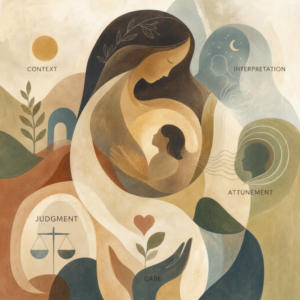
In this context, the “mother” represents something much broader than a person. It represents context, interpretation, attunement, judgment, and care. Without this layer, information can exist in abundance, but meaning does not fully form. Before I founded Village Medicine, I trained as a homebirth midwife here in Seattle. That experience shaped how I understand medicine more than anything else in my career. Homebirth midwifery is practiced in real time, without the buffer of a hospital system. It requires clinical precision, but it also requires presence. You are constantly making decisions based not only on data, but on pattern recognition, relationship, and the subtle shifts happening in front of you.
In that setting, vital signs matter. Clinical thresholds matter. Safety matters deeply. And at the same time, you learn when to intervene and when to wait. You learn to track changes before they become measurable problems. You learn to stay attuned not only to physiology, but to the person experiencing it. You learn to hold steady attention in moments that are intense, vulnerable, and unpredictable. A midwife is not simply managing a process. She is interpreting a living system in relationship. That is what I mean by the “mother” function. When I look at modern medicine, I see a system that has become extraordinarily skilled at gathering and processing information. We have access to advanced laboratory testing, imaging, diagnostic criteria, algorithms, protocols, and now increasingly powerful forms of artificial intelligence. These tools have improved safety and expanded what is possible in ways that are undeniable.
And yet, I continue to see patients who arrive with extensive workups, multiple diagnoses, and well-constructed treatment plans—and still feel unwell. Or, just as importantly, unseen.
This is not simply a gap in knowledge. It is a gap in meaning.
There is a difference between information and understanding. You can have normal labs and still feel unwell. You can have abnormal findings that do not clearly explain what is happening in your body. You can follow a treatment plan that is technically correct and still not improve in a meaningful way.
When care is driven primarily by data, without sufficient context, it becomes fragmented. It becomes protocol-driven. It becomes disconnected from the lived experience of the patient. The result is care that may be correct on paper, but incomplete in practice.
There is another layer to this that is equally important. The “mother” was never meant to exist in isolation.
Traditionally, care happened within a village—through multiple caregivers, shared responsibility, collective observation, and continuity over time.
No single person was responsible for holding the entire picture. Care was distributed, but aligned.
At Village Medicine, when we use the word “village,” we are not using it as a metaphor. We are describing a structure. A coordinated clinical team. Providers who communicate with one another. A shared understanding of each patient’s full picture. A system where care is continuous rather than episodic.
This includes your primary provider, other clinicians within the practice, our front desk and support staff, the physical space we have built, and you—as the patient. You are not outside of this system. You are part of it.
There is also a dimension of care that is often left unspoken. In both midwifery and medicine, there is an aspect of healing that involves presence, meaning, and a patient’s internal experience of what is happening in their body. For some, this is spiritual. For others, it is simply the deeper question of what their body is asking of them.
This layer does not replace medical care. It sits alongside it. When it is ignored, patients often feel disconnected from their own healing process. When it is acknowledged, it can create clarity, engagement, and a stronger sense of agency.
At the same time, we are practicing within a larger healthcare system that is moving toward efficiency, automation, and scale. These shifts are understandable. They are responses to real pressures. But they come with a tradeoff. As systems become more efficient, they often become less interpretive. They can process information, but they do not inherently generate meaning.
At Village Medicine, we have made deliberate choices to structure care differently. We prioritize time for interpretation, space for collaboration, and continuity across visits. This reflects a core belief: that investing in depth upfront leads to more accurate care and more durable outcomes over time.
Our work is not only to gather information. It is to make sense of it—within the context of a whole person, within a coordinated system, and over time.
This model depends on partnership. The patients who tend to benefit most are those who come prepared, who maintain a clear and up-to date understanding of their own health information, who share their history in detail, who track what their body is telling them, who ask questions, and who remain open to exploring root causes.
“You are not a passive recipient of care.
You are an active participant in a system designed to support you.”

Technology will continue to evolve. Data will continue to expand. Our tools will become more sophisticated. These are not trends to resist.
But tools do not replace the foundational elements of care: context, judgment, relationship, and meaning.
The question “Where is the mother?” is ultimately asking: Where is the layer that makes information useful? And who is holding it?
In my training as a homebirth midwife in Seattle, that layer was never held by one person alone. It existed within a relational field—a small, focused village.
At Village Medicine, we are working to rebuild that structure in a modern clinical setting. Not as an idea, but as a practice. Because healing was never meant to happen in isolation.
In Gratitude
Dr. Tara Johnie Shelby
Naturopathic Physician
Founder & CEO, Village Medicine
This reflection was inspired by a piece I recently read by Abi Awomosu, which
gave language to something I have been witnessing in medicine for years.